

At the start of every scholarship cycle, most programs look similar. But as the cycle progresses, operational differences become difficult to ignore.
Some programs move through the cycle smoothly – applicants understand the process, reviewers make consistent decisions and leadership receives clear insight into participation and outcomes. Others begin to experience operational friction.
- Applicants ask repeated eligibility questions
- Review coordination becomes manual and time consuming
- Reporting is not available when executives ask about impact
At that point, leaders begin asking a more direct question: Is our scholarship program actually delivering the value we expected?
For many organizations, this is the point where confidence in the program begins to shift.
When Scholarship Programs Start Raising Executive Questions
Scholarship programs often begin with a clear purpose. Over time, however, they are evaluated like any other significant investment, with leadership focused on whether the program is delivering the outcomes it was designed to achieve.
Executives begin asking questions such as:
- How many eligible applicants are actually applying?
- Are participation rates increasing or declining?
- Are recipients completing their programs?
- How much effort does it take to run the program each year?
- Can we clearly demonstrate the program’s impact?
Programs that struggle operationally often find these questions tough to answer.
In many cases, the issue is not a lack of infrastructure. Programs may already be supported by established processes and external partners. The challenge is that reporting often stops at activity, with limited visibility into true program impact or long-term outcomes.
As a result, leadership may see what is happening in the program, but still lack a clear, real-time or on-demand understanding of its value or performance.
Visibility: The First Requirement for ROI
For most executives overseeing education benefits, the first obstacle is visibility.
Many scholarship programs can report basic activity metrics such as number of awards issued and total dollars distributed. Those numbers are helpful but they rarely answer leadership’s most important question: Is this investment producing meaningful outcomes?
High-performing scholarship programs go further by tracking indicators that help leadership evaluate the program strategically.
Examples include:
- Participation rates among eligible populations
- Year-over-year application trends
- Award distribution patterns
- Recipient academic progress
Without this level of visibility, scholarship programs can be arduous to evaluate internally. Tracking these metrics across the entire scholarship lifecycle is often what allows organizations to connect program activity to measurable impact.
Utilization: Why Many Scholarship Programs Still Underperform
A second challenge many organizations encounter is utilization.
A scholarship program may be well funded yet still experience low participation. Even when families are aware of the benefit, they may not fully understand how it applies to them or how to navigate the application process. This friction has real consequences.
When eligibility requirements, timelines or application steps are unclear, applicants hesitate to engage. Participation declines and the program’s perceived value weakens over time. High-performing programs address this by removing uncertainty from the applicant experience.
They typically provide:
- Clear, easy-to-understand eligibility guidelines
- Structured and well-timed communication throughout the application cycle
- Accessible, reliable applicant support when questions arise
Many organizations underestimate how strongly communication and applicant support influence not just participation rates but overall program perception.
Operational Stability: Where Many Programs Break Down
Administrative complexity is another area where operational differences become visible.
Many scholarship programs do not struggle because they are entirely manual. They struggle because key parts of the process are spread across disconnected workflows, multiple handoffs and systems that were never designed to work together.
This often results in:
- Applications submitted through multiple channels
- Documents reviewed and tracked through email
- Reviewers working across separate scoring files
- Payments managed outside of the core workflow
At a small scale, these processes may appear manageable. As programs grow, they begin to introduce operational risk.
Common problems include:
- Limited visibility into application and review status
- Inconsistent documentation across the program lifecycle
- Increased coordination effort between teams
- Heavier administrative workload during peak cycles
High-performing programs reduce this friction by creating more coordinated and centralized approaches to scholarship program management, allowing application intake, evaluation and disbursement to operate as part of a connected process rather than isolated tasks.
Organizations that improve process coordination and structure often see meaningful gains in efficiency, consistency and reporting clarity.
Governance: Protecting Fairness and Credibility
Selection decisions represent one of the most sensitive parts of any scholarship program. Applicants expect fairness. Organizations must ensure decisions remain consistent and defensible across cycles. Without structured evaluation practices, inconsistencies can appear between reviewers or across program years.
High-performing programs protect the integrity of the selection process through:
- Documented eligibility and scoring criteria
- Consistent reviewer guidelines
- Decision documentation tied to program standards
What High-Performing Scholarship Programs Look Like
When organizations compare scholarship programs during planning cycles, the operational differences become clear.
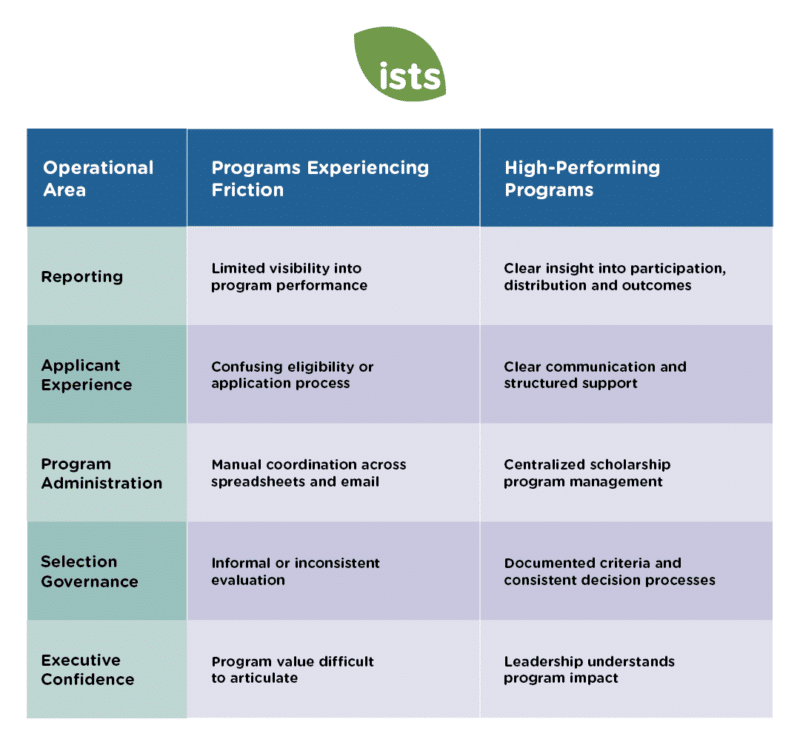
These operational differences often become visible only after a program begins scaling.
When Scholarship Programs Become Strategic Assets
Scholarship programs represent a meaningful investment in employees, families and communities.
As budgets increase, expectations increase with them. Executives want clarity around participation, operational efficiency and long-term program impact. Programs that prioritize visibility, applicant experience, operational stability and governance are far better positioned to demonstrate their value over time.
ISTS supports organizations by managing scholarship and educational assistance programs end-to-end. Through centralized program infrastructure, structured evaluation processes and dedicated applicant support, organizations gain the operational clarity needed to run programs efficiently while maintaining transparency and consistency.
For organizations investing significant resources into scholarship programs, operational clarity is often what determines whether the program remains a benefit or becomes a measurable, high-performing initiative.
If your scholarship program is becoming harder to evaluate or explain internally, it may be time to reassess whether it is delivering on the outcomes it was designed to achieve and whether your current structure is equipped to support that. We’re here to help.