
Nashville weather tends to be predictable: four distinct seasons, some snow and ice in the winter that lasts a few days at the most. Hot, humid summers that warrant a large glass of iced tea in the afternoon. Fall and spring are robust and colorful that have the locals out and about for much of a day.
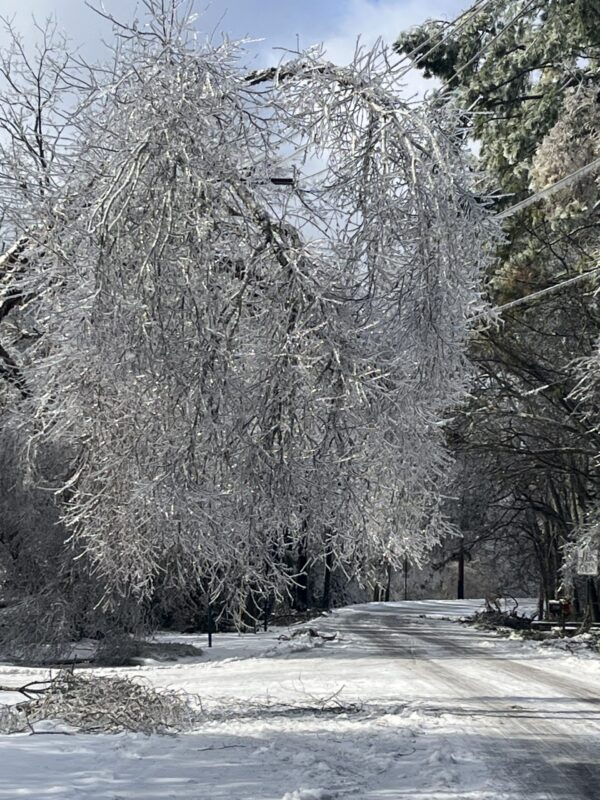
A few weeks ago, we got the motherload – an ice storm like none other. After several hours of freezing temperatures and pelting ice, the trees had had enough and began falling by the thousands. Crashes and bangs were constant. Power lines were ripped from their poles, transformers exploded. The roads looked like forests with thick branches and debris everywhere. Two inches of ice covered everything and as the sun peaked through the clouds and the sky turned blue, the result was a diamond-like covering on leaves, branches, limbs and entire trunks. It was as though mother nature had turned everything into glass: stunning and scary.
At first, my husband and I handled the power outage easily by putting on skull caps and coats in the house but by sundown things were more than a bit chilly inside. Our situation, like that of many others, was uncomfortable but completely manageable with a space heater, gas stove and some ingenuity. As the hours turned days and days to over a week, I began to think about those who didn’t have a space heater or even someone to check on them.
Walking around our neighborhood, we ran into people who usually drive into their garages and don’t engage much. Now they were approaching and sharing their situation and asking about ours. We gathered mobile numbers from people who rarely waved. This shared natural disaster was bringing people closer.
My morning routine changed from ‘check email’ to ‘build fire’. I took a few minutes to journal, feeling no rush at all. I had to drive about four miles to get internet service, which slowed my login time but brought a deeper sense of calm. I found myself getting sleepy earlier as my body naturally aligned with the sun. We listened to the radio at night, warm in our puffy jackets.
A friend offered me a shower and it felt incredible. We hung quilts and kept a pot of water heating on the stove. The temperature in our protected space was a cozy 65°. The low in my bedroom was 13°. In a double skull cap and under two down comforters, I slept like a baby and was reminded how it feels to camp.
On the morning of the 10th day, power came back on. Initially, I was excited but by dusk, I missed the quiet evenings. The next day we started a fire and began removing the quilts from the doorways. I journaled and then hopped online and got to it. Now more than a week since we got power restored, all is back to the oh-so-connected world. I’m trying to keep some of the routines, like not jumping online so quickly. The temptation is great.
This is a longer-than-usual blog for me. Perhaps because I recently experienced a slow down in the passage of time without all the entertainment around us all the time. I feel a bit less rushed, but it’s there – the rush, encouraging me to press and push.
So, what can we learn from a natural disaster, regardless of its scope? For me, it is that mother nature is very clearly in charge – and perhaps her message is: “You have access to your resilience. Will you use it?”
And what’s the work analogy? I think it’s that we will benefit from discomfort, from stretching, from looking for our dependencies and weaknesses. What, if turned off, would damage or destroy our business? Running through those scenarios at work will not prevent us from experiencing things out of our control but they will help us identify what we need to have in place just in case.
At home, we are grateful for and will keep our gas stove and fireplace. We’ve added a generator to the wish list and are making sure we have ample batteries and blankets. We are not wired to be super preppers but do want to be smart and able to provide shelter to others if needed.
At work, we are discussing what work natural disasters could be and are making sure we have a plan and test each possibility before it’s real-life so that if/when it happens, we will be well-practiced and calm in our response.
– Becky Sharpe, CEO